
Every experienced Illinois commercial contractor knows the grind. Your estimating team spends forty hours pulling together a meticulous takeoff, tracking down supplier quotes, and sharpening their pencils to the absolute limit. You submit the proposal, wait weeks, and either lose to a competitor who underbid by twenty-five percent, or you win, only to realize the project schedule is an absolute minefield and your profit margin is going to evaporate before the foundation is even poured.
In the current Illinois commercial construction landscape, volume is no longer the metric of success. Margin is. Local bid pricing in Chicagoland has flattened due to heavy competition, while sudden tariff shifts on core materials like copper and steel conduit keep driving up electrical and plumbing costs. Throwing bids at the wall to see what sticks is a quick way to burn out your estimators and take on projects that lose money.
The most successful contractors in the Midwest are not the ones bidding on every single job. They are the ones who have mastered the art of selection. Here is how you can use preconstruction data to filter out high-risk, margin-killing projects before you ever waste time downloading a set of blueprints.
1. Watch Out for the Addendum Avalanche
An addendum or two is standard. A continuous stream of major changes right up to the bid deadline is a symptom of a much larger problem: poor design and chaotic project management.
When an architect or owner issues dozens of structural changes, material substitutions, or design clarifications at the eleventh hour, it tells you that the construction documents are incomplete or flawed. If you win a project built on bad documents, your profit margin becomes entirely dependent on your ability to fight for change orders later. While some contractors tolerate this, it destroys your field efficiency, strains your relationship with General Contractors, and ties up your cash flow in endless disputes.
Track the velocity of these changes. If a project is constantly being pushed back or modified with fundamental scope changes during the live bid phase, it is often wiser to step away. Let your competitors tie up their bonding capacity on a chaotic job site while you focus on clean, well-scoped opportunities.
2. Verify the Historical Behavior of the Project Owner or GC
Who you work with matters just as much as what you are building. Before investing days into a proposal, you need to vet the entity holding the purse strings or managing the job site. You need to know if an owner consistently awards projects exclusively to the lowest bidder, even when that bidder has a track record of non-performance. If they do, your sharp, accurate, high-quality bid will likely be passed over anyway, making your estimating time a complete sunk cost.
Manually chasing down old bidders lists and bid results across dozens of scattered county, school district, and municipal portals takes hours of phone calls and internet digging. This is why smart estimators use platforms like DataBid to run a quick background check during preconstruction.
By checking the DataBid Company Directory, you can instantly look up the historical tendering patterns of Illinois public buyers and General Contractors. Within a single dashboard, you can see their active projects, who they typically award contracts to, and their exact history of low-bid awards. This lets you see if they are a fair player or a low-ball buyer before you spend forty hours on a takeoff.
3. Stop Chasing the Noise and Find Your Sweet Spot
The biggest trap for a modern estimator is the sheer volume of available work. When you are looking at generic bid boards with thousands of open invitations, it leads to decision paralysis and rushed, sloppy estimating.
To protect your margins, you must define your company's sweet spot and ruthlessly filter out everything else. Your sweet spot is the exact project type your field crews excel at executing, inside the geographic radius where your labor pool is strongest.
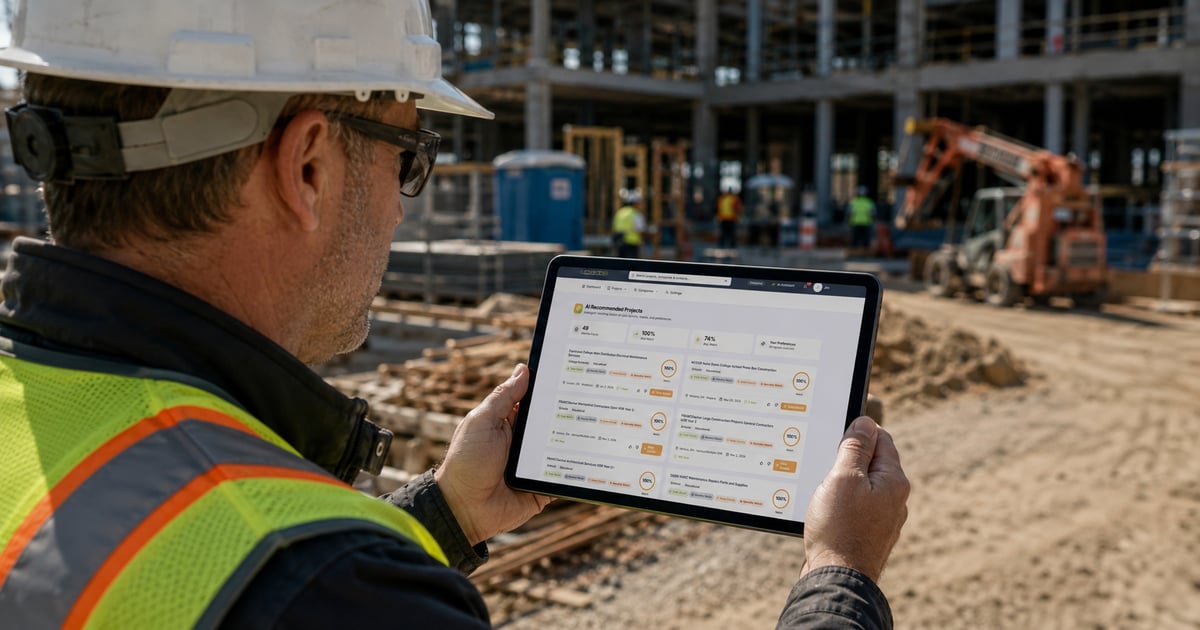
Instead of forcing your team to log into fifteen different public procurement sites every morning just to find these specific jobs, you can use automated tracking tools to do the heavy lifting. DataBid has a public reporting department that contacts over one thousand public entities every single day across Illinois. By setting up customized filters on your dashboard for your specific trades, regions, and project stages, you can instantly block out the noise and only see the high-margin opportunities that match your company DNA.
Conclusion: Let Your Competitors Bid Blindsided
Bidding on every project that comes across your desk is not a growth strategy. It is a gamble. By treating preconstruction as a strict vetting process, you protect your estimating team from burnout and shield your balance sheet from high-risk projects.
The goal of utilizing modern market intelligence is not just to find more work. It is to find the right work. When you use DataBid to gain deep visibility into local Illinois project histories, upcoming pipelines, and complete bidder profiles, you can let your competitors bid blindsided on the high-risk projects while you target the contracts that build real wealth for your company.


